
Raising solar installation standards in Ghana
Understanding mismatch theory
Dream Renewables has trained over 1,000 people across Ghana and installed 16 solar power installations alongside our trainees. While visiting communities we have frequently been asked to fix faulty solar power systems, or check working systems for issues. This is what we have learnt.
Written By Desmond Agbadi
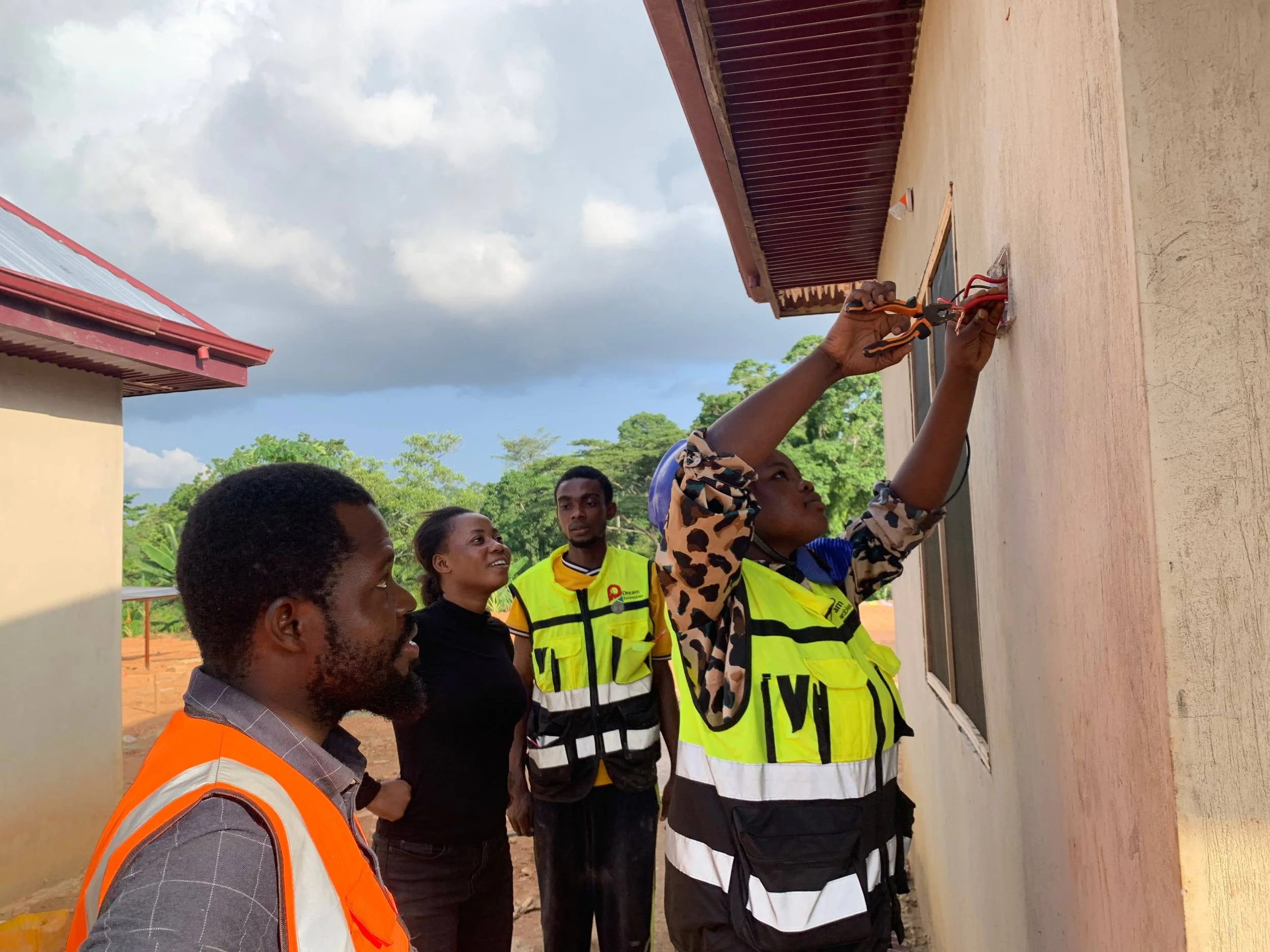
Dream Renewables has observed across Ghana a number of technical challenges and low installation standards within the solar industry. In many cases, technicians and installers carry out solar installations without proper attention to key system design principles and safety requirements. Common issues include poor cable selection - where installers use any available cable without considering whether it is rated for AC or DC applications and a lack of attention to correct cable sizing, which affects efficiency and safety. Additionally, many systems are installed without appropriate protective devices such as breakers, surge protection devices (SPDs), or fuses etc. leaving systems vulnerable to faults and damage.
Another very common and widespread technical issue is mismatch losses, which occur when system components are poorly matched or improperly connected, leading to significant reductions in overall system performance. These challenges not only compromise the efficiency and safety of installations but also undermine public trust in solar energy as a reliable solution.
At Dream Renewables, we recognize these technical gaps as opportunities - opportunities to raise professional standards, build installer capacity and promote excellence in solar design and installation through our training programs across the country.
What is mismatch in solar PV systems?
Mismatch occurs when the electrical characteristics (such as voltage and current) of individual solar panels connected in a string or array are not identical. In simple terms, when panels with different power ratings, orientations, shading levels, or ages are combined, they no longer perform at their optimal levels - instead, the entire system’s performance is pulled down by the weakest module. Think of it like a running race where a team has to cross the finish line at the same time, if one person slows down, everyone slows down. The same applies to your solar panels.
Causes of mismatch losses
Mismatch can occur due to several factors including,
Different module ratings: Using panels of varying wattages or current ratings in the same string.
Partial shading: When one or more panels are shaded by trees, buildings, or dirt while others receive full sunlight.
Orientation and tilt differences: Installing panels at different angles or directions reduces uniform exposure to sunlight.
Temperature variations: Panels operating under different temperatures produce varying outputs. This may be as a result of uneven shading, differences in airflow, or panel positioning and tilt angles. For instance, panels near the edges of an array may receive better cooling from wind than those in the middle, while others may be partially shaded by nearby objects, dust accumulation, or even wiring layouts/configuration that reduce heat dissipation. Since higher temperatures cause a decrease in voltage output, panels that are hotter will operate at a lower voltage, impacting all the other panels in the series and leading to overall system output losses.
Age and degradation: Mixing new and old panels causes performance differences due to natural degradation over time.
Each of these factors contributes to power losses, commonly known as mismatch losses, which can range from 2% to over 10% depending on the system design.
Why knowing about mismatch matters
Ignoring mismatch doesn’t just reduce energy yield - it can also cause long-term damage. Over time, panels subjected to unequal current flow may experience hot spots, leading to overheating and even permanent damage. This reduces both system efficiency and the lifespan of your investment. For end-users, this translates into:
Reduced energy generation
Shorter system life
Poor return on investment
For installers, it reflects poor workmanship and lack of technical knowledge, which undermines trust and credibility in the solar industry.
Preventing mismatch: Best practices
At Dream Renewables, we emphasize precision and professionalism in every solar installation. To minimize mismatch losses, we train our participants to:
Use identical panels within a string - same manufacturer, model, voltage and current rating.
Avoid shading through conducting proper site assessments before installation.
Ensure uniform orientation and tilt angles across all panels connected to a single MPPT.
Match strings properly when connecting to inverters or charge controllers.
Use bypass diodes and monitoring tools to detect and correct mismatch early.
By applying these practices, installers can achieve optimal performance and ensure every watt of sunlight counts.
Our commitment at Dream Renewables
Mismatch may seem like a minor technical issue, but its impact on system performance is major. Every solar installer must understand that attention to detail defines excellence in this industry. A professionally designed system not only performs better but also builds trust in solar as a reliable solution for Ghana’s clean energy future.
Dream Renewables remains committed to raising the standard of solar installations in Ghana through high-quality, practical training and continuous capacity building. Our approach goes beyond theory - we train installers to understand why professional standards matter and how to implement them effectively on the field.
As we continue to engage technical institutions and communities across the country, our goal is to build a generation of solar professionals who design and install systems that meet global standards - efficient, safe and sustainable.
